Thursday, July 4, 2019

WHO MAKES HISTORY IN OUR TIME?


Everything that matters today affects all of us

Some hundred years ago our sense of history was firmly rooted in our national identity. For people in my country history first of all was Dutch history. For the English, for the French, for Americans and so on it was much the same.

The western world as we know it was not yet born, alliances did exist, but they served national interests and ambitions first of all. Twice we experienced the demise of German ambitions – and perhaps we witnessed the end of German history altogether. French history had long been dead and buried, probably with Napoleon, and no Charles de Gaulle could reverse that.

But doesn’t this apply to almost all nations? In the post WWII era most of the world moved towards multi-polarity, a situation in which no single nation effectively makes history unless is does so in conjunction with others. Thus, another Europe emerged – another European story, very different from the history - or histories - preceding it. Has this Europe effectively made history?

In any case I can say that Dutch history no longer exists. And as far as I can see, the same applies not only to French but also English history. And hasn’t American history too grown more vague and undefined? A few decades ago we could still think in terms of an American epoch, a kind of new Rome, lasting for centuries. But it didn’t come. The US are now just another dinner plate at the G20 summit. And so are Russia, China and most certainly ‘Europe’. One may be stronger (in whatever dimension) than the other, they may switch places, but no American, Russian or Chinese era will emerge.

Perhaps the only thing that is left is world history, from now on. Whether we like it or not. 
  • I write this in a time which lacks historic significance, we live in a void (awaiting something epic )
  • In the mean time we still have a story, or stories to tell
  • But the great challenges we face and probably any great future event will be global, they are bound to affect our entire planet.
No single country will tackle the climate issue or our decreasing biodiversity. Both indeed are questions of global significance. Therefore whatever history is effected, it will be global history.

Even so, single countries can make a significant contribution. It still matters we exist, wherever and whoever we are.

Thursday, April 18, 2019

OUR GAME OF EMPIRES (*)

(*) "Our" meaning: in our present time.


The war that according to some of those who actually survived 
the trenches, had proved to be “not worthwhile”.


The emperors disappeared,
but the fight was not over.
In came new emperors:
emperors of collectivism
and emperors of sheer madness.

A real world War arose.
Most of all, WWII was the Great Generals War,
directed by enlightened and persuasive politicians
(on the Allied side)..

After that freedom and democracy
gained the upper hand
(though wars and dictatorship still remain).

Yet empires still exist, and they still rule:
the empires of commerce and finance
plus the empires of military power.

The great powers have substantial overkill capacity,
enough to destroy the planet many times over.

So the question arises: what really do we want.

What will the next great strive be about?

Will it be: who is the smartest and the strongest [1],
or who will best help preserve our planet?


[1] ) Are they the same?

Sunday, June 24, 2018

ITS FICTION IS THE GREATEST GIFT OF EVERY GENERATION


Teddy Roosevelt portrayed in the TV-series The Alienist

Not the facts, but our fantasies count most in the future

I was watching a new TV-series called The Alienist. It is set in New York the late 19th century, the era of the Robber Barons, with J.P. Morgan as their Zeus at the pinnacle. The Catholic Church is involved intimately. The series offer an excellent representation of the rich and the poor, the vicious and the righteous. Teddy Roosevelt is portrayed as the New York commissioner of police, a position he never held. But he is pictured as a hero of a kind, so the American sentiments about him are fully satisfied.

There is much to say for history to be explained with fiction. The TV-series present a very credible view of the world of the late 1890’s in America. And yes, much government effort went into stemming the tide of corruption. As a president Teddy Roosevelt in fact succeeded in crushing the Robber Baron monopolies.  It is what the civilized world has always done, to pass its greatest fiction, myths and legends, alongside its history, and sometimes intermingled, from generation to generation.

And then there is fiction elevated to become history. The genesis of Christianity is the great example. The four Gospels are an effort in deliberately historicizing fiction that already floated for many decades. Our era is based on the birth date of someone who never existed. The life of Jesus was created as the people’s most desired fiction of God’s love and personal sacrifice but also as a mighty vehicle to command the historical process thereafter. Thus the powerful fantasy of one religion became the historical backbone of our entire civilization.

In fact, most civilizations have some historicized fantasy at their heart. Similarly quite a few myths are the heart of national histories. Think of King Arthur and his Camelot, or Homer’s Odyssey.

Given the vast and detailed historical records of our time, it is far less likely for our fiction to become historicized in a similar way. Even so, the day may come when people are led to believe that Superman really existed. Or it may be the the reverse: history being turned into legend. This may be the case, for instance, with the story of Anne Frank or the life and times of John F. Kennedy and his Camelot.

Otherwise, even without becoming historicized much of the fiction of our generation has the potential to far outlive our history. Think of the many epic movies we pass on, both of fiction and fictionalized history. Who will know, many thousands of years from now, which one was true and which one wasn’t? In the end the truth of it all doesn’t really matter. It is what we wish to believe.

Saturday, June 3, 2017

CALL ON THE AMERICAN PEOPLE


YOUR PRESIDENT HAD ALL RIGHTS AND OPPORTUNITY TO RAISE HIS POINTS, HIS OBJECTIONS OR DOUBTS

I think he should still be given this opportunity. The participant nations in the Paris Climate Treaty should preferably take the initiative soon. The should cordially invite the US president to clarify his case, and perhaps offer help in overcoming severe obstacles.

I am expressing this from my deepest personal – family – roots in the history of the American people. And in a sense, given that ancestry, I am American too, even as a 100% Dutchman. All of us – in the United States and Europe – share this fundamental history, and the values that went with it. 

It would truly be a shock to us all if we cannot share one of the greatest challenges in human history, the preservation of the livelihood of our planet.


Sunday, May 7, 2017

SOUL IN A SHELL


Tonight I watched the movie Ghost in a Shell, with Scarlet Johansson playing the lead role as a woman whose brains were transplanted into a humanoid robot. Much of her quest is about retrieving her personal memories prior to the transplant and getting to understand why this happened in the first place.


I wonder if at any time in the future a brain transplant of this kind would become feasible, if any kind. But even to imagine this is a powerful thought which takes me to the age old human fascination with life after death. With a brain transplant, I assume, its actual mortality still prevails. As an individual we may survive longer, but we still die. A living, organic brain thus far is the only vehicle to carry our memories, our feelings, our thoughts, in short: our soul. Perhaps we can transplant it, but we cannot transfer it to another medium without questioning whether such transfer would indeed retain the original living conscience or just another version, or copy of it. The original would be effectively dead.

Perhaps, indeed in the far future, many eras from now, there might be another answer. We stand at its very beginning. At best we can today leave a digital copy behind of our memories and thoughts, our voice even, images and movie clips in whatever format. It is the very thing that I have been building up, in the course of the recent years: the box which I have dubbed “Digital Me”. The box in fact is an external hard drive with some 250GB disk space. I hope to live long enough (I am 65) at least to double the total data stored.

Digital Me contains my life in pictures, home movies, video clips, text documents with notes, articles and books published, professional documents, special files about topics of my interest, in short: a collection of everything about me that will remain accessible (long) after I am gone. If the Egyptian pharaohs had access to similar technology, they would not have built their pyramids. But however far I take this collection of things in my mind, it will never really be a ‘copy’ of me in the fullest sense.

But indeed, in our time we already have come very far in storing and reproducing (printing or projecting) our lives’ memories, far beyond any type of collection in history. Our heirs and descendants might even have too much of it, this almost infinite heritage of (digital) images, movies and memories of our generations. It is for them to decide what to do with it, a time goes by, and perhaps along the lines of new technologies that could bring these memories ‘to life’.

With Digital Me I am doing my bit, or rather: my bytes. And hopefully, there will be those in the future who will enjoy a walk through my digital mind and relive some fragments of ‘me’ as I have enjoyed them alive and kicking.

Sunday, November 13, 2016

LIVING IN AUGMENTED REALITY


It is time to throw the use of the term ‘virtual' out of the window

Recently I explained the wonders of digital virtual reality to an uncle and aunt, both in their 90's. I told them I had just had my first experience of 3D, using a Playstation VR headset while ‘being’ Lara Croft in Rise of the Tomb Raider.  When I told them about the real-life sensation of walking around in a virtual room, my aunt was bemused. “But isn’t the real world good enough?”  Of course, in most respects reality cannot be beaten, however much 3D games and movies using computer generated imagery in the mean time have filled our brains with awe inspiring sceneries and sensations that ‘reality’ can never provide.

In this light one could say that the use of the term ‘virtual reality’ holds a contradiction. For rather than that they are trying to increasingly match reality, the movie and games industries have – greatly - surpassed it. Virtual reality today is far more than reality, not a little less. Secondly, I think that the greatest leap forward will not be any kind of equivalence of the real and the virtual, but the intrusion – and ultimate fusion - of one another. In this world the virtual and the real together become ‘enhanced’ or ‘augmented reality’ (AR), a term already widely used.

Examples of this fused AR already exist, for instance Google Glasses and Hololens (Microsoft), both still being subject to further development.  Perhaps the same applies to Pokémon Go, which became an instant hype when it was launched. It pushed people out of their homes and catch imaginary digital monsters in the streets, in parks and public buildings, “blending digital fantasy and tangible reality in exciting and sometimes dangerous ways,” as one review phrased it. The hype soon passed, it was just a teaser of AR things to come.

Nonetheless AR applications also include the realities which already have become standard, e.g. in the car industry, through manifold electronic devices (automatic backwards in-parking, warning signals in dense traffic). It won’t take long before cars are talking to us, not just our electronic navigation device.

Let's think of the long term prospects. One website offering some predictions tells us: "augmented reality is exciting new technology, and there are probably ways to use it that will emerge in the coming years that we can't yet even imagine".

Still, it is not difficult to picture this blended world of the natural and the digital, where people move around, anywhere and anytime, doing various transactions along the way, either buying or selling, and thus fulfilling their niche in a globalized (as much as purely regionalized cyberspace. This may seem very abstract, but in fact we already have made our first steps in such a multidimensional space. Just apply Pokémon Go technology to your grocery store. and the next minute your purchases are ready to be picked up (it is a reality in China). Or alternatively, click your car with any remote device (probably your Smart Phone), and it will drive out of the parking by itself and open the driver's door before your doorstep. Next you produce and sell a valuable 'thing' or service, you press "print" or "send", you do the transaction, and it will literally materialize at some distant spot, whilst costs and revenues are automatically recorded in your bookkeeping, subtracting taxes (e.g. V.A.T.) along the way. When doing this, you may be comfortably sitting on a beach side, or perhaps doing some typing work in a flexible office.


Increased personal flexibility and mobility translate into flexible and mobile on-demand production and service outlets with also do the pickup and delivery at your fingertip's notice. We transact, we communicate, we "see" all we need to respond and co-operate in AR networks, in trains, in our own car (when it is directed by satellite systems) etc.

Let's just hope we can still enjoy real-life human company at dinner time and some physical paperwork if need be.


Sunday, August 21, 2016

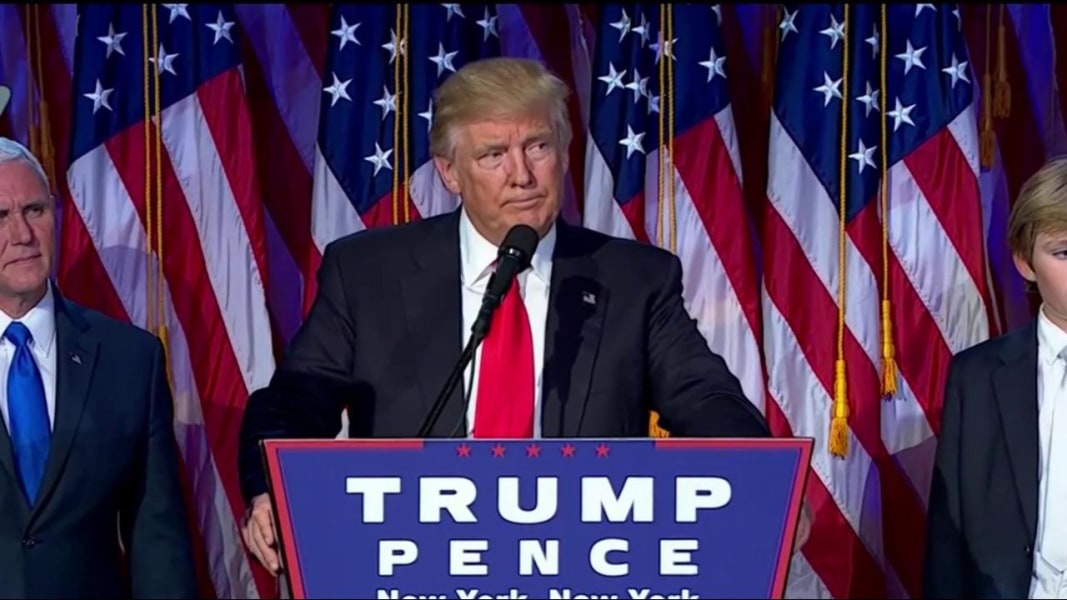
LET THE WORLD PREPARE FOR US PRESIDENT DONALD TRUMP


Dislike for Hillary Clinton- however competent she may be – is as widespread as the current disgust among many when they think of Donald Trump. And on the other side, the millions of who like Trump thoroughly, regardless his (in)competence, far outnumber those who positively want Hillary back in the White House. Just think of it, the Clinton couple in the Oval room for a second time around simply cannot work. It is too boring, too old school.

But Donald Trump is a true challenge. It has been long since a man ostensibly lacking any credential for the position is fighting for the US presidency. An aura of excitement, outrage and unexpected turns of history somehow seems to lurk behind the curtain. No doubt there are many who simply want to let him have it. If need be, we’ll clean up afterwards (or so quite a few might think).

I am a moderate person with moderate views and driven to understand both sides of any story – and of any person. It too see the downsides of a third Clinton term – and perhaps even of a continued Democratic presidency – and most certainly it is not difficult to imagine mani-fold shock waves in our world in the event of Trump’s victory. And the America that would lift him to the saddle most certainly is not the America I cherish. However, we have to face the fact that in our present time the main stream populace is entitled to some kind of satisfaction.

Rightly or wrongly, many people feel sidetracked and grossly ignored particularly in the face of estranging phenomena such as Arabic terrorism and increasing economic inequality. Clinton offers no convincing cure, nor does Trump, but at least he echoes what people feel about the many disruptions in their world.

But for Trump himself, matters become too serious now to continue his strategy of intimidation. He has to make sense somehow. You can hear his advisers crunching their brains. What should this presidency be, if ever?

I believe that Trump, no matter what he says, deep in his heart wants to secure peace. He is not a hawk for the sake of it. Nonetheless, he will wish to shake things up, probably whatever he can get his hands on. He will turn friends into enemies and the other way around. He will ignite fierce debates about the rights and wrongs in our world. All of it, in a way, despite himself.

We should not shrink in horror when thinking about the prospect of Trump. Let’s prepare, and make the best of it, if it comes to it.

Friday, January 8, 2016

THE END OF MATERIALISM


Will it also mean the end of liberalism? 

A book should be written, I believe, about the rule of finance and economics that pervades the policies particularly of Western nations. We all see it at work. It is going just one direction, at ever greater scale.

We have become mere consumers. All of us. And we carry grave burdens to continue enjoying this. In the course of the post-WWII era this seeming world of material comfort has turned into a condition of mass slavery, supported by the global system of fierce capitalism. The majority of the people in our world are reduced to just names and figures in the accounts of our creditors.

Those who manage the world’s financial resources money have a steadily increasing power compared to those who have almost none of it. We experience a gradually increasing divide between the people who can readily enjoy the richness of our planet’s resources and those who can’t. 

Fukuyama prophesied the end of history and the ultimate predominance of economic liberalism and democracy. “What we may be witnessing is not just the end of the Cold War, or the passing of a particular period of post-war history, but the end of history as such: that is, the end point of mankind's ideological evolution and the universalization of Western liberal democracy as the final form of human government”.  After his publication a growing number of question marks and arguments have been raised in disagreement. At the turn of the millennium the world was confronted with new conflicts and attacks at the heart western liberalism.

Dissatisfaction with the world order of markets and global finance is becoming increasingly violent, massive and destructive. Let us truly understand the driving factor of today’s so-called terrorism. Out of what despair and misery was it born? Don’t think it has anything to do with religion. It is the same everywhere in all times. Religion is the most common disguise of ignorance and dissatisfaction in history. 

How do we best respond to it? Dot we defend our fortress of wealth and accomplishments with similar (or rather: even greater) military force, simply to crush it? And let us broaden the scope: sooner or later, violent aggression will arise out of our societies too. An increasing mass of dissatisfied people, disgruntled slaves and further victims world wide of – essentially – western exploitation of the earth’s resources.

But even without the force of aggression, can we come to the notion ourselves, that our world cannot persist the way it is? What do we defend, and what actually is the best way to do it? We don’t need the cries and misdeeds of the disgruntled to see the dead end road we have been riding for quite a while.

In 2014 Fukuyama commented that humanity's control of its own evolution will have a great and possibly terrible effect on the liberal democracy. Well, this is the question: it is either our common sense or indeed, it is the dictatorship of the few that will determine our future, with whatever force it requires. And either way, the foundations of true liberalism and democracy are already shaken by the very state we are in at present, when figures and statistics command the world.

Friday, June 5, 2015

IN THE VIRTUAL UNIVERSE THERE ARE COUNTLESS CREATORS


Game Makers are out to rule your brains
 
I have a good young friend who recently bought the latest version of Playstation (PS4). It is a marvel to see what it can do. My friend plays a variety of games and most likely, from what I have watched him do thus far, he is a crack at it. With PS4 you can jointly play with friends online or with anybody else in the world who is logged on to the same game.
 
Out of this it is not difficult to visualize an emerging virtual universe in which real life people roam freely in this realm of almost infinite options, through their self-created character – or avatar - which (or ‘who’) has all kinds of wondrous capabilities far exceeding our own real life capabilities. Subsequently we can experience every adventure or journey – either alone or with friends – served up by the numerous game makers who constitute the true creators of this universe.
 
At present we can say that the world of computer games and our material world are totally separate. But this will change over time. We will cross the strict borders between the real and the virtual, which will then increasingly become a blur. Real life and virtual life are bound to merge. This is what the current games and gaming facilities are gradually training the younger generation of my good friend familiarize with.
 
But there is a twist. In actual fact our individual liberties in the virtual universe are restricted. Our actions are largely guided by the minds and rules of those who created the hardware and software of our games (and other applications) in the first place. If you want to be successful in Playstation – or X-box – games, you must learn to understand their minds and logic and not apply your own. There may be many instances where the option you would wish to have simply is not available and where you have to settle with a choice of actions that seem ineffective or illogic. Increasing the players’ flexibility thus would seem an important aspect of the future evolution of (online) gaming.
 
Then there is the increased sense of real experience in virtual reality. Probably many people share my sensation of reality when you simply drive a car, traveling through any kind of landscape in currently available games. How will this sensation be when one day we all wear 3D-monitors like the one depicted below.


But I could also simply wish to enter the virtual universe and meet with friends abroad, go shopping in some great virtual mall, or do sightseeing in an ancient city, like Rome at the time of Emperor Augustus. The possibilities are infinite.
 
Ultimately we can all become creators in the virtual universe. Perhaps this is the true journey for which we need to prepare.

Sunday, August 31, 2014

THE TERROR OF GOOD INTENTIONS

Through different ways – and experiences - I have learned to be suspicious of any gesture of good will or generosity, unless it is clear what the author of the gesture gets out of it for him (or her)self.

The first experience by which this notion grew onto me had nothing to do with interpersonal relations but with inter-state relations: one country providing development aid for the other. 

Essentially I came to believe that decades of development aid throughout the world have gone down the drain very much because the interests of the western countries involved were rarely made explicit right on the table. It is impossible to believe that western programs of development aid or development cooperation, as they were carried out in the nineteen eighties and nineties – which was when I was more closely involved - came out of pure altruism. Of course they didn’t. 

Development aid grew in an atmosphere paternalism and post-colonial guilt. Western countries solemnly committed themselves to a percentage of their national income as gift to developing countries. Huge sums of money, manpower and political debate went into the effectiveness of this aid: did it really develop these countries?

An extensive institutional infrastructure and numerous policy documents accompanied this one way traffic. Inspections were carried out, reports were written, disappointments highlighted. Corruption undermined the process in many instances, warnings could be issued, compliance – by the beneficiaries – to the rules of the game was reinforced. Sometimes the flow money was suspended. Etcetera. 

The leading morality was that of enforced gratefulness. The psychology of having to say thank you, which is the way a civil servant in one of Holland’s development countries told it to me, one day. The total subordination to the terror of good intentions, which is how I came to see it. You have be grateful for something you didn’t ask for.

Much later, I observed similar processes between people. I came to realize that we should always be suspicious of someone who professes to be good just for the sake of it. Pure altruism cannot hold. There has to be a personal interest too.

Still, there is a twist. As a rule, we hesitate to be too explicit about our personal interests. We prefer to project goodness, largely for the impression we make. It can happen at any given occasion when someone asks you: “Can I help you?”. When it happens in a shop, you immediately know that the intention (and interest) of that person is to sell something, a service or a material item. We know that “sales talk” always is double talk at the same time. We take it for granted.

But then a total stranger offers you his assistance, let’s say: to carry your bags on your way to the train. What is your immediate response? I would say, we would be suspicious initially, or at least cautious. Can we trust this person, does he want some compensation? Should we readily offer some compensation? Etc. The same applies to anyone offering financial help or some other assistance essential to you.

Perhaps we should avoid any deal – even with close friends – where there is no substantive quid pro quo. When you risk a situation where you have to show gratitude at unexpected moments. It is the beginning of our submission to something (and someone) we cannot control. 

Therefore, as a rule, we should be clear (at least to ourselves) about our interests in respect of our fellow human beings, and demand similar clarity from any other. Why do I want to help you? Well, it is because I know you will help me another time, when I need it. Or, if it is between countries: because your country will be able to produce which I need. It is only under these conditions we can avoid the psychological conundrum of having to say thank you when actually you wish you hadn’t.

Thursday, August 28, 2014

AWAITING THE FURTHER PROCESS OF HISTORY

For most of its existence humanity was destined to be content with the status quo. This was either because early humans, like their predecessors, lacked the drive or the immediate pressure for ongoing invention and advancement or because the prevailing leadership kept their people largely ignorant of their potential for such advancement. Advancement as we know it is a recent phenomenon, however much it seems to be innately tied with the essence of our humanity. We simply cannot imagine a status quo. 

Indeed, our ongoing advancement equally stems from need: population pressures, environmental pressures and many other – related – issues which can only be resolved when humanity presses forward in its technology and in its institutional framework for peace and prosperity of our world’s population. There is no choice but to go ahead, the alternative being the certain collapse of our civilization.

The current leadership of our world, however, seems to experience great difficulty in articulating such road ahead. If anything, their constituency is urging them to go backwards and succumb to raw populism. None of the competing political forces offer a credible alternative that can rally voters away from their prevailing conservative preferences. Besides, almost all energy is spent in at least preserving the attainments of our recent past, as we currently experience in the EU and as similarly is the experience of the people of America. Wealth, wealth creation, international security, a solid future for our children, all of this has become rather more uncertain than it has been throughout the greater part of our post-WW II universe.

Clearly, the status quo is not an option. We live in a world which by every measure is unsustainable. We cannot dream of some nostalgic paradise. It is no longer there. We may redefine our needs, our ideas of society and well-being – and I am convinced that we should – but the only road ahead is one that is paved with substantive, progressive ambitions at unprecedented scale.

We will not see such ambitions surface any time soon. It will require a new momentum, most likely arising from a sense of imminent disaster, but hopefully some imminent opportunity too, the nature of which is anybody’s best guess at present.

The present state of stagnation is a reminder of the fact that history has no preset course. It is up to each generation to rise to the challenge and visualize an attainable, mobilizing future. True history is made by those who have the stamina and the persuasive power take us to new and promising frontiers. We have almost forgotten what it looks like and our younger generations haven’t had experience of it. But they too will know when they see it or at least, when they see the need for it.

Humanity still has a long way ahead. The confines of our planet will largely define the parameters by which it will have to secure the habitat and livelihood of many billions of people over the longer term. I am convinced that we haven’t yet reached our ultimate potential in our means to achieve this, neither in technological terms nor in terms of politics and societal thinking. But we have reached the point of exhaustion of the thinking that has brought us to the point where we are today. This includes our ability to effectively respond to the great disparities in the conditions and prospects of the people populating our world. The true project of humanity is to address these disparities to the longer term benefit of all: their access to resources, their sustainable development and livelihood and their quest for a meaningful life however we may define it.

Our current global political and institutional framework may not necessarily suffice. It is either too fragmented or it lacks the power and the means to mobilize the nations of our world towards a long term common goal. Old history still stands in the way but so do vested national and ideological interests.

It took some two decades before the true scope of the twentieth century became manifest, both in its drawbacks and in its vast array of possibilities. Much of the groundwork had been done in the preceding decades. The historic process centered around competing ideologies, out of which - as we see it – free market liberalism emerged victorious. National democracies have become the main residences of the people’s sovereignty. The greatest challenge for the present century is both to retain this foundation of government and at the same time strengthen the role of global institutions governing our critical resources. We should hope that it won’t require similar cataclysms as in the last century to finally get there. 

(2011)